No direct reports. No formal authority. No excuses.
Leading without a title is one of the hardest roles you'll ever have — and it's where influence becomes everything.
There is a sentence I have said to more leaders than I can count. I say it because I keep seeing the same role underestimated, the same challenge minimized, and the same leaders blindsided by how hard it actually is.
"Leading without direct reports is one of the most difficult roles you will ever have. And this is where influence becomes everything."
Every time I say it, I watch something shift in the room. Relief, usually. The recognition that what they've been struggling with isn't a personal failing — it's a genuinely hard problem that most organizations don't prepare you for and most leadership development programs don't address.
The hardest leadership role nobody talks about
When you lead without direct reports, you have no formal authority to fall back on. You can't overstep the boundaries of the person's actual leader. You can't use salary, bonuses, or advancement as levers. The corporate incentives that organizations rely on to drive performance — none of them are yours to offer.
And yet the team's effectiveness — which is often a cross-functional team — its ability to function, collaborate, and deliver, depends in part on how you show up every single day. This is the real work. Influence isn't a technique you can learn in a workshop. It is a byproduct of who you are and how you carry yourself — your consistency, your integrity, your willingness to advocate for the people around you even when there's nothing in it for you.
I remember a learning how a previous Stantec CEO who was mentoring his successor give this very important advice: they recommended the leader take a role in a non-profit — not as a detour, but as deliberate preparation.
The reasoning was this: in a non-profit, there are no corporate incentives to lean on. No salary negotiations to leverage. No bonuses to dangle. If you want people to show up, to commit, to do difficult work together toward a shared goal, you have to earn that. You have to learn to inspire, to motivate, to give people genuine agency, and to lead through advocacy and support alone. You have to answer the question every leader without authority eventually faces:
How do you move a team toward a goal when you have nothing to offer them except your leadership?
That question is the whole game. And the leaders who can answer it — really answer it, not just in theory — are the ones who become the kind of leader others want to follow.
The leader sets the level of trust
Patrick Lencioni's Five Dysfunctions of a Team puts absence of trust at the very foundation of everything that goes wrong. Not trust in the sense of liking each other — trust in the sense of being willing to be vulnerable with each other. To admit uncertainty. To say "I got that wrong." To ask for help without it feeling like an exposure.
I genuinely believe the leader sets the ceiling for that trust. Not through a team-building exercise or a values workshop — through what they are willing to model first. When a leader names what they want to be held accountable for, and means it, the team gets permission to do the same. When a leader demonstrates that it's psychologically safe to have a difficult conversation, the team learns that disagreement isn't dangerous.
For the leader without direct reports, this matters even more. You cannot rely on positional authority to create safety. You have to build it from scratch, through behaviour, every time you walk into the room. The question isn't whether you have influence — it's whether you've done the work to deserve it.
And here's what surprises people who haven't been inside a high-performing team: they are not harmonious. They are productive. Debate is the norm. Disagreement happens in the open rather than in the hallway. When you're working with engaged, capable people, you should expect that not everything will be agreeable — and you should be concerned when it is. Silence in a room full of smart people is not consensus. It's a symptom.
You are always somewhere in the cycle
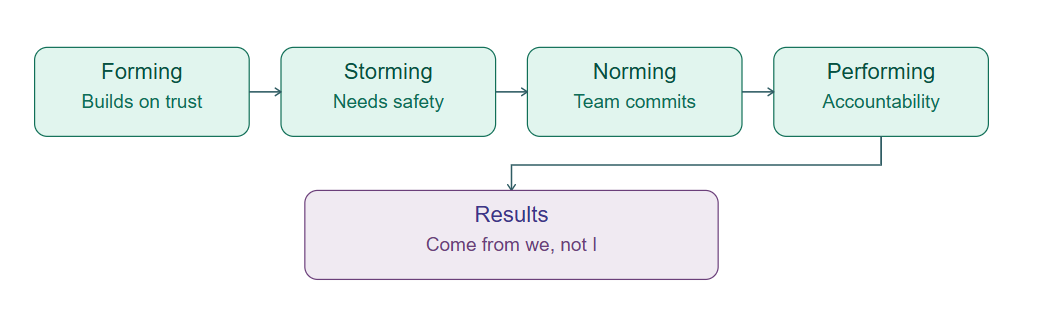
Bruce Tuckman's model of group development — forming, storming, norming, performing — is one of the most useful frameworks I return to with leaders, because it reframes what most people experience as failure as something far more predictable: a stage.
Forming is the polite beginning. Everyone is on their best behaviour, and conflict is avoided. Storming is where the real work starts — where friction surfaces, roles get tested, and the team figures out whether it's safe to disagree. Norming is where the team finds its rhythm and commits to it. Performing is where it operates with trust, clarity, and genuine momentum.
What most leaders don't fully reckon with: every time someone leaves the team or someone new arrives, you go back to the beginning. But here's what that actually means for a team that's done the work — going back to the beginning doesn't have to mean going back for long. A team with a strong foundation of trust and psychological safety can move through forming and storming in a matter of days. They already know how to disagree well. They already know the norms. They just need to extend that foundation to include the new dynamic.
The cycle restarting is not the problem. The duration of each stage is the signal. When a team has genuinely done the trust work, cycling through is fast. When a team is spending months stuck in storming — unresolved friction, side conversations, conflict that never gets named in the room — that's not a stage. That's a culture problem, and it almost always traces back to a leader who hasn't yet created the conditions for trust and safety.
For the leader without direct reports, who can't rely on formal authority to move people through that cycle, this is where influence is built or lost. You are either the person who helps the team find its footing quickly, or you are the person waiting for someone else to do it. There is no neutral.
The sentence the team needs you to say
When I work with leaders navigating this role, the unsaid sentences are almost always connected to trust — either the leader's trust in their team, or the team's trust in the leader. The conversation being avoided is usually the exact one that would move the team forward through the cycle.
Here is the reframe I offer: if you can see it, and you care about this team, it is your place. Not to overreach. Not to go around the formal leader. But to be the person who raises it thoughtfully, who frames it as a question, who opens the conversation rather than closes it. That is influence. That is what leadership looks like when the title isn't there to do the work for you.
And when you're ready to have that conversation, I often recommend that you start with a question and then a statement — in this order.
First: "How do you think you are doing?"
This question does more work than most leaders realize. It reveals self-awareness — or the absence of it. It tells you whether the person already knows what you're about to raise, or whether they're genuinely in the dark. It gives the other person the dignity of going first. Their answer will tell you exactly how to proceed.
Then, once you know where they are:
"I have something uncomfortable to share, and I'm sharing it because I care about you and about this team."
That second sentence changes the temperature of the conversation before the difficult content even arrives. It separates the message from the relationship. It signals investment, not judgment. And it reminds you — in the moment you most need reminding — why you're doing this in the first place.
Two sentences. That's the entry point. Everything else follows from there.
What's the sentence you've been avoiding? You don't have to name it word for word — but naming it to yourself is usually the first step.
If you're navigating influence without authority and you're ready to go deeper on this work, let's talk. This is exactly what coaching is for.